
Start Dates
Duration
Fees
Learning Activities
The Professional Diploma in Development Finance prepares you to operate where the future of development is being decided. Funding flows into Africa are shifting from traditional aids and grants toward blended and catalytic capital. Donors now ask for verifiable outcomes, not activity counts. Governments seek solutions that reduce fiscal pressure while crowding in private investment. Impact is moving from project level outputs to system level change that endures. This program equips you to thrive in that new reality.
Development finance is the cornerstone of sustainable growth, especially in Africa where more than 350 million people remain excluded from formal financial systems and small and medium-sized enterprises, which account for up to 80 percent of jobs, face an annual financing gap of over USD 330 billion. By learning how to channel resources through agriculture, infrastructure, healthcare, education, and SMEs, you will acquire the tools to bridge those gaps and convert limited resources into powerful levers for inclusive development.
While on this program, you will work with the instruments now reshaping the field including impact investing, microfinance, green and blue bonds, climate adaptation funds, and diaspora and local currency facilities. You will also practice how to build bankable pipelines, price and share risk, address foreign exchange and political risk, and align incentives so that investors, governments, and communities all win.
This diploma also responds to the new accountability agenda in development. Donors are increasingly requiring transparent impact metrics, value-for-money assessments, and real-time learning mechanisms. You will learn how to design financial programs that not only attract capital but also demonstrate measurable outcomes such as jobs created, incomes improved, and access to essential services expanded.
The demand for skilled professionals in development finance has never been higher. Across Africa, innovative finance is reshaping how resources are mobilized and deployed. By completing this program, you are preparing to lead in this critical frontier. You will graduate with the knowledge and credibility to influence policy, guide investments, and design solutions that ensure finance becomes a true engine of inclusive growth, poverty reduction, and sustainable development.
By completing this program, you position yourself to lead policy design, shape investment committees, and guide donors and implementers toward solutions that are both commercially sensible and socially transformative. You will graduate able to mobilize capital, target constraints, and deliver outcomes that last, ensuring that finance becomes a true engine of inclusive growth and sustainable development.

Gain in-depth knowledge of the financial instruments, models, and strategies used to promote inclusive economic growth.
Learn how to apply financial tools to address challenges in sectors like agriculture, education, healthcare, and infrastructure, improving livelihoods and economic resilience.
Lead the charge in leveraging finance to reduce poverty, close inequality gaps, and foster sustainable, long-term development.
Foundations of Development Finance
This introductory module lays the foundation for understanding the role of finance in achieving sustainable development goals (SDGs). It explores the key principles, actors, and institutions that shape development finance globally and locally, as well as the various approaches to funding projects that generate both social and economic impact.
Actionable Insights:
Financial Inclusion and Microfinance
Financial inclusion is critical to enabling individuals and SMEs in underserved regions to access capital, build businesses, and escape poverty. This module focuses on the design and implementation of microfinance programs and other financial inclusion strategies that reach low-income communities.
Actionable Insights:
Infrastructure Financing for Sustainable Development
Infrastructure development is key to economic growth, yet financing these large-scale projects can be challenging. In this module, you will explore how development finance can bridge the infrastructure funding gap, with a focus on financing models for energy, transportation, water, and sanitation projects that have a long-term social and environmental impact.
Actionable Insights:
Agriculture and SME Financing for Inclusive Growth
Agriculture remains a key driver of economic development in Africa, yet smallholder farmers and agribusinesses often face significant barriers to accessing finance. This module explores financing mechanisms tailored to agriculture and SMEs, helping you design solutions that promote inclusive growth and enhance rural livelihoods.
Actionable Insights:
Impact Investing and Blended Finance
This module introduces you to impact investing—where financial returns are combined with measurable social and environmental impact. You will explore the growing field of blended finance, where public and philanthropic capital is used to mobilize private sector investment in development projects.
Actionable Insights:
Risk Management in Development Finance
Development finance often involves working in high-risk environments, whether due to political instability, economic volatility, or environmental hazards. This module will teach you how to identify, assess, and manage the risks inherent in development finance projects, ensuring financial sustainability and positive outcomes.
Actionable Insights:
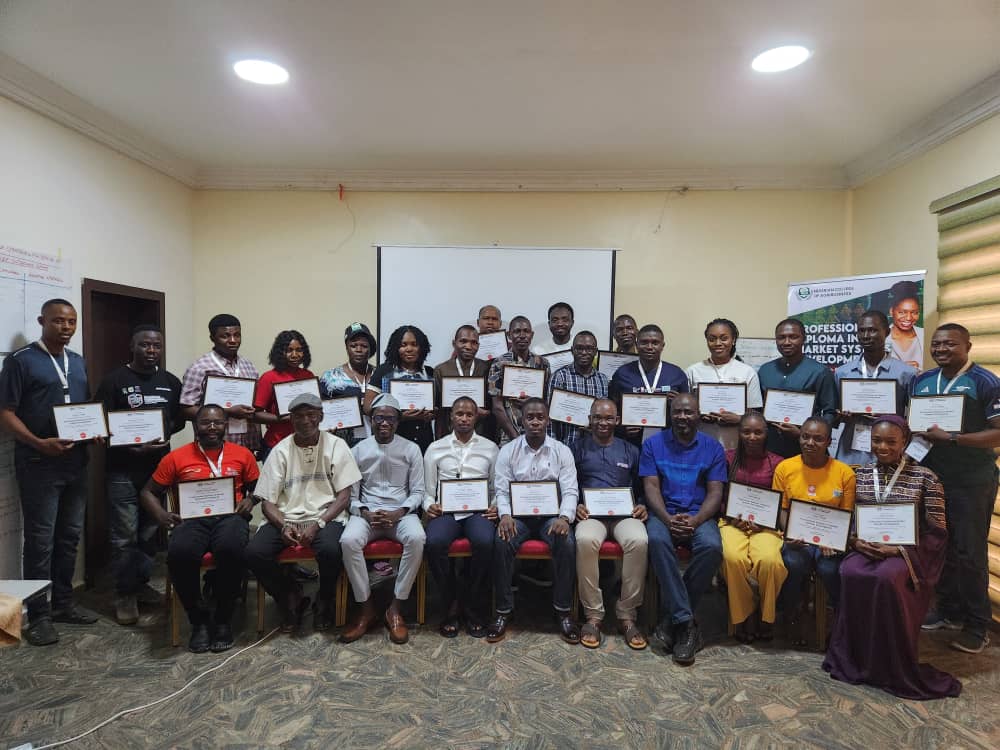
No other institution in Africa offers such a comprehensive approach to agribusiness and development sector education as the Nigerian College of Agribusiness. We provide a unique blend of academic rigor, practical expertise, and industry connections. Here, you will learn from experienced faculty members who are experts in their fields and deeply engaged with the latest advancements in their industries.
We leverage interdisciplinary knowledge and the latest research to enhance our programs, ensuring they are relevant and impactful. At NCA, you will continuously engage with thought leaders who are constantly shaping the dynamics of their industries and after graduation, you will be a life-long member of a vibrant alumni community that continually foster cross-disciplinary learning and networking.
STEP 1: Click on the Apply Now icon below and complete the Application for Admission Form for the course.
STEP 2: Submit the completed form
STEP 3: Once your application is successfully evaluated, you will receive your Admission Letter confirming your acceptance into the program. The letter will also contain details for tuition payment and enrollment.
Click on the link below to fill the application form and begin the process.
N750,000 (Instalment payment plan available)
Get monthly marketing tips and exclusive discounts straight to your inbox